

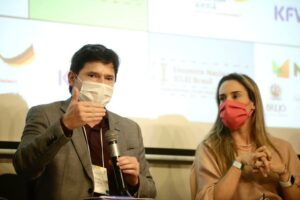
Recife, the 16th most vulnerable city to the effects of climate change according to the Intergovernmental Panel on Climate Change (IPCC), will be the first in Latin America to participate in a project to create insurance against climate disasters. This Wednesday (16), during the 1st National Meeting of ICLEI Brazil and with the presence of the Director of KFW – Development Bank of the German Government, Martin Schröder, the Deputy Mayor of the City of Recife, Isabella de Roldão, [Name], signed the Letter of Intent to join the ProUrbano project – Urban Infrastructure Insurance Facility (UIIF). The document was also signed by the Executive Secretary of ICLEI South America, Rodrigo Perpétuo, and it had been approved by the Mayor. John Fields the previous night (15), during the ICLEI Regional Executive Council Meeting for South America (RexCom).
The main action of the initiative, led by ICLEI – Local Governments for Sustainability and funded by the German government through KfW – Development Bank on behalf of the Federal Ministry for Economic Cooperation and Development (BMZ), is to support the creation of and access to insurance as part of consistent disaster risk management strategies in Latin American cities. The UIIF is part of the Global Insurance Partnership for Resilience, or InsuResilience (IGP), and aims to support municipal governments in protecting critical urban infrastructure and vulnerable populations from natural disasters caused by extreme weather events.
The Executive Secretary of ICLEI South America, Rodrigo Perpétuo, highlighted that Recife was not selected for the project, but chosen for its permanent, firm, and long-standing climate commitment. “We need to ensure that cities are prepared and receive the necessary support for resilience through the development of the insurance market and infrastructure. And there is no better city to receive this project in a pioneering way than Recife.”
In thanking Recife for being chosen for the ProUrbano experiment, Isabella highlighted that it is an innovative insurance policy, but one that may become the most widely used in the world. “I feel grateful that Recife was chosen consciously. At the same time, it pains me to know that Recife wasn't chosen by chance. We are extremely vulnerable to climate change, and this cannot be ignored. The impacts of climate change have gender, race, and class dimensions. And we need to take important actions to ensure minimal harm to people.”
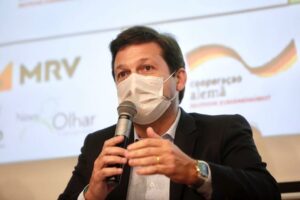
Campos assured that his team will be committed to the project, aiming for the best insurance model. "Recife is the first city in Latin America to sign and participate, and therefore we have an obligation to make it work. Showing that this is a path that strengthens our city is our commitment," said the Mayor.
Schröder highlighted that KfW was working with a greater focus on climate mitigation and that, with this initiative, it is taking a step forward in the field of adaptation. “We seek to provide impetus through innovation. Where can we allocate scarce resources more intelligently? In the insurance world, this is a field that is still relatively unexplored, and it is fascinating to begin this project,” said the KfW Director.
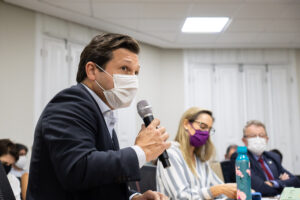
“The biggest challenge for cities is financing adaptation measures,” added the president of RexCom, ICLEI Special Envoy for Latin America, and Secretary of Economic Development for the State of Pernambuco, Geraldo Julio. “It’s a challenge that’s been presented, and everyone is studying and learning about it. This is an innovative project and could be the path to adaptive and resilient infrastructure here.”
More about the Project
The UIIF is jointly coordinated and implemented by the ICLEI World Secretariat (ICLEI WS), the ICLEI South America Secretariat (ICLEI SAMS), and the ICLEI Mexico, Central America and Caribbean Secretariat (ICLEI MECS), which will work together to establish regional insurance services by 2025. Technical support and financial grants provided by the UIIF are limited to municipal governments that are capable and committed to exploring the potential of including climate risk insurance solutions in their own strategies and municipal Disaster Risk Management framework.
By expressing interest in participating in the UIIF, Recife will be able to receive technical and financial support to access urban insurance coverage against increasing risks caused by extreme weather events, through the development of tailor-made insurance products. Over the course of one year, the capital of Pernambuco will engage in dialogue with insurance companies, financial institutions, organizations, and government departments to facilitate the assessment of the city's exposure to natural disaster risks and to understand the relevant legal, political, and financial conditions, as well as existing gaps in disaster risk financing.
Recife is internationally recognized for its resilience measures.
In addition to signing the Letter of Intent, during the session “Resilience and Adaptation in Latin American Cities – the Case of Recife,” the city was also honored for its recognition as a Resilience Node by the Global Coordinating Committee of the Building Resilient Cities 2030 (MCR 2030) initiative, of which ICLEI is a part. Resilience Nodes are cities that demonstrate a political and technical commitment to taking measures to address the risks of climate disasters, becoming more inclusive, safe, and sustainable. Besides Recife, only Medellín and Campinas have been recognized as Resilience Nodes in South America.
Carlos Ribeiro, Secretary of the Environment for the City of Recife, recalled the municipality's progress on the climate trajectory, whose first Greenhouse Gas (GHG) Emissions Inventory was launched in 2015. The city of Recife is globally recognized as a pioneer in public policies for climate action. Associated with ICLEI since 2015, it has already participated in a series of initiatives, such as the two phases of the Urban-LEDS project, which assisted in the implementation of climate governance (Committee and Executive Group on Sustainability and Climate Change – Decree No. 27,343/2013). The partnership also resulted in the preparation of Greenhouse Gas (GHG) emissions inventories, the GHG Emissions Reduction Plan (2016); the Climate Risk and Vulnerability Analysis and Adaptation Strategies (2019); and the Local Climate Action Plan (2020). and in the installation of photovoltaic panels at the Women's Hospital of Recife (HMR) and the Educational Center of the Jaqueira Eco-center, focused on climate education (2021).
Recife also has Law No. 18.011/2014, which provides for the Sustainability and Climate Change Response Policy; Decree No. 33.080/2019, which declares recognition of the global climate emergency; and Complementary Law No. 02/2021, which establishes the Master Plan and emphasizes measures to address climate change.
Furthermore, to expand adaptation measures in the sectors of economy, urban mobility, urban transformation, and sanitation, Aries, within the context of the CitInova project, with GEF6 resources managed by MCTI, is developing, together with the City Hall, WayCarbon, and ICLEI, the Sectoral Adaptation Plan for Recife. This initiative, scheduled for launch in May 2022, was also presented during the session of the 1st National Meeting of ICLEI Brazil.
The role of the private sector
The session also included reflection on the role of the private sector in building local resilience strategies. Thaís Morais Souza, Sustainability Specialist at MRV, ICLEI partner in 2022, He highlighted that the company's strategic objectives include contributing to the advancement of climate adaptation in municipalities. "MRV's intention, now in partnership with ICLEI, is to engage in dialogue with municipalities, providing vulnerability analyses. When constructing a new development, we can already show the municipality the climate scenarios for the neighborhood, such as water scarcity, landslides, heat waves, etc."“



 Português do Brasil
  Español
  English (UK)