
ICLEI South America and the Mercocities network present the Regional Position of Local and Regional Governments for COP17 on Desertification, a joint policy document addressed to the Secretariat of the United Nations Convention to Combat Desertification (UNCCD) and key actors involved in the implementation of the Rio Conventions, including national governments, international organizations, and strategic partners. The document will be presented at the 17th Conference of the Parties to the UNCCD (COP17), held from August 17-28, 2026, in Ulaanbaatar, Mongolia, under the theme “Restoring Lands. Restoring Hope”.
The document was jointly prepared by ICLEI South America and Mercocities, with contributions from its member governments and other subnational governments committed to climate action, including signatories of the Global Covenant of Mayors for Climate and Energy (GCoM).
With this positioning, the two networks seek to strengthen the recognition of the role of subnational governments in combating desertification, land degradation, and drought, bringing focus to the region's actions and advocating for integrated implementation with the agendas of climate change, biodiversity, and sustainable urban development.
Desertification, land degradation, and drought already affect more than 401,000 hectares of the planet's land surface, compromising the food, water, and climate security of millions of people. Although they are usually associated with rural areas, these processes have causes and consequences strongly linked to urban dynamics—from the unplanned expansion of cities to soil sealing, including the loss of green infrastructure and the increase in heat waves, droughts, and floods.
South America holds some of the planet's largest reserves of biodiversity and strategic ecosystems for global climate and water regulation, but it faces an accelerated advance in land degradation, loss of vegetation cover, water stress, and forest fires. In this scenario, local and regional governments are at the forefront of the response, acting in territorial planning, sustainable management of natural resources, climate adaptation, and ecosystem restoration—and translating the commitments of the Rio Conventions into concrete actions.
Reaffirming the recognition gained at COP16 through the Declaration and Call to Commitment promoted by the GTF, local and regional governments in the region are calling for joint progress on nine priorities:
- Integrate the UNCCD objectives into the urban agenda., combining sustainable land management, water and food security, and nature-based solutions in territorial planning;
- To promote synergy between the three Rio Conventions. — desertification, climate and biodiversity — in urban sustainable development policies;
- Strengthen multilevel governance, with permanent mechanisms for coordination between national, regional and local governments;
- Expanding access for subnational governments to financing and technologies., recognizing their role as indispensable implementers of ecological restoration and climate adaptation;
- Strengthening capacities and South-South cooperation, in partnership with universities, research centers and specialized organizations;
- Promoting social justice and a just transition, with a gender focus and recognition of the role of women, indigenous peoples, family farmers and youth;
- Define indicators, evaluate results, and ensure public access to information., with open data, baselines, and public monitoring dashboards;
- Promoting a resilient territorial transition, combining land restoration, water and food security, social inclusion and the creation of green jobs;
- To consolidate a regional agenda for political advocacy., which will fuel the future global positioning of Constituency LGMA.
The position paper includes, as an annex, experiences from ICLEI and Mercocities member governments that are already putting this agenda into practice. Highlights include the Caatinga Fund and the Reforestation Law (Law 15.430/2026), achievements of the advocacy of the Northeast Consortium; the SIDEAP and the Water Care Plan, from Montevideo; the participatory restoration of wetlands and reforestation with one million native trees in the province of Azuay, Ecuador; the PlanClima SP, from São Paulo; and the green infrastructure and nature-based solutions from Santiago, Chile.
The annex is completed by initiatives from Niterói, Bahia, the Federal District, and Ceará, in Brazil; from six Colombian cities—Montería, Bucaramanga, Pereira, Yopal, Villavicencio, and Pasto—and from the province of Tierra del Fuego, in Argentina.
The statement also recognizes the leading role of the Northeast Consortium in promoting innovative policies to combat desertification and restore degraded territories, consolidating it as a reference for Brazil and South America in this agenda. The text is inspired by the positions of the Local Governments and Municipal Authorities (LGMA) constituency, the Call to Commitment of the Global Taskforce of Local and Regional Governments (GTF), and the Open Letter of the 5th ICLEI Brazil Meeting in the Northeast, as well as the Mercocities documents towards COP16, COP30, and WUF 12 and 13.
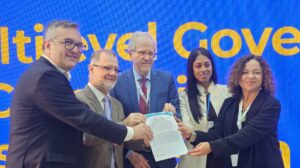
The document was presented on Thursday (27) to the UNCCD regional representative in Latin America and the Caribbean, Laura Meza, during the session “Multilevel governance in the fight against desertification”, which dealt with the role of states, municipalities and subnational consortia in the implementation of the UNCCD and in the territorialization of climate action.
In presenting this document, ICLEI South America and Mercocidades reaffirm their commitment to actively contributing to the implementation of the UNCCD and call upon the Parties and the international community to recognize and strengthen the role of local and regional governments as strategic partners in building resilient, inclusive, and sustainable territories.
Access it here Complete Regional Positioning in the ICLEI Library!
 Português do Brasil
  Español
  English (UK)