

What happens when water scarcity ceases to be temporary?
The concept of “"water failure", developed by the professor Kaveh Madani, The winner of the 2026 Stockholm Water Prize describes a chronic condition in which water systems can no longer return to their historical equilibrium under prevailing climatic, ecological, and institutional conditions.
This distinction is important. Water failure signals that underlying conditions have changed. The challenge is to respond to immediate water scarcity while adapting to a long-term reality in which historical water conditions may no longer provide a realistic basis for planning. For cities, this means planning for a changing water reality, preventing further degradation, and building resilience across the water system.
This was the focus of a discussion at COP17 of the UNCCD, where ICLEI and the Global Alliance of Water Operator Partnerships They organized the side event “Preventing water shortages: Cities, utilities, and river basins on the front lines of drought resilience.“The speakers explored the practical and policy changes needed to move from a short-term response to crises to long-term water resilience.

1. Bankruptcy due to insolvency is a diagnosis, not a declaration of defeat.
Recognizing water scarcity means acknowledging the scale and structural nature of the challenge. Instead of moving from one water emergency to another, the concept can help create the political space for long-term responses and new partnerships between cities, public utilities, watershed managers, communities, and national institutions.
São Paulo offered an example of this long-term approach. José Renato Nalini, The Executive Secretary for Climate Change of the Municipal Government of São Paulo highlighted the planting of half a million trees since 2021 as part of the city's efforts to combat soil degradation and restore its aquifer reserves.
“The city of São Paulo has had its Climate Action Plan – Planclima – since 2021 and is taking seriously the desertification that is spreading across the planet. The planting of half a million trees since then is a strategy to restore our aquifer reserves. It is also the only city to maintain the OIDA, Integrated Operation in Defense of Water, fully operational, evidence of its efficiency in protecting water sources,” Nalini emphasized.
2. Urban water resilience begins outside the city.
Municipal governments, water and sanitation companies, watershed organizations, and other stakeholders must work together to reduce water loss and overexploitation, diversify and reuse water supplies, restore ecosystem functions, strengthen drought preparedness, and mobilize investment. André Viola , a member of the Departmental Assembly of Aude (France), highlighted how good water management is inseparable from good soil management. Healthy soils retain water, reduce surface runoff, promote infiltration, and protect landscapes from degradation. For this connection to become operational, political leadership, coordination, and intersectoral investments are necessary.
Anton Earle, ICLEI's water systems coordinator, emphasized that we too often treat urban water insecurity as a problem of pipes, pumps, or dams. This discussion made it clear that it is also a problem of land, soil, and governance. A city's resilience depends on what happens across the entire watershed—how rainwater is absorbed, how ecosystems are protected, how public services are supported, and how institutions work together before the crisis turns into collapse.
3. Water resilience means working with multiple sources and solutions.
There is no single infrastructure solution to increasing water stress. B. Purevdagva , The governor of the capital and mayor of Ulaanbaatar outlined a multifaceted approach: increasing storage infrastructure while simultaneously protecting rainwater infiltration, expanding water recycling and reuse, and reducing non-revenue water.
4. Small actions add up.
Saldan Oduntuya , a member of Parliament and former Minister of Environment and Climate Change of Mongolia, highlighted the cumulative power of thousands of smaller interventions. Rainwater harvesting on roofs, local infiltration measures, waste reduction, and community management may seem modest individually, but on a large scale, they can strengthen the resilience of entire urban water systems.
5. Water resilience is a governance challenge.
Cities cannot guarantee their water future on their own. They need a significant role in the management of river basins, because urban resilience depends on the health of the land, soil, and upstream ecosystems.
This also means breaking with institutional compartmentalization. Actions related to water, land, and climate need to be planned, financed, and implemented jointly, reducing fragmentation and the burden on local governments. The three Rio Conventions offer an opportunity to better align urban resilience, ecosystem restoration, and climate adaptation around shared outcomes in the area of water. ICLEI will continue to develop these themes throughout 2026, including at the COPs on Biodiversity and Climate and the United Nations Water Conference.
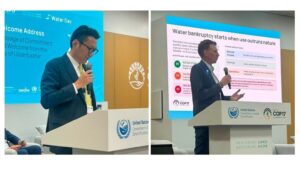
B. Purevdagva, Governor of the Capital and Mayor of Ulaanbaatar, and Anton Earle, Water Systems Coordinator at ICLEI.
Put , originally published in CityTalk.
 Português do Brasil
  Español
  English (UK)