

Strengthening subnational and local governments in the climate agenda and partnerships between all levels of government and sectors, in addition to combating illegal deforestation, are measures identified as fundamental to overcoming the challenges involved in implementing more resilient, sustainable, inclusive, equitable, and just territories in South America, the most unequal region in the world and one of those most affected by the climate crisis. This vision was shared by political leaders, experts, activists, representatives of civil society and private companies from South America at events during the 27th United Nations Conference of the Parties on Climate Change (COP27), which took place from November 6 to 17 in Sharm el-Sheikh.
Leaders advocate for greater involvement of subnational and local governments, youth, marginalized communities, and indigenous peoples in climate agenda decision-making, through the establishment of multi-level governance. As summarized by Bráulio Diaz, Regional Manager of Institutional Relations and Advocacy at ICLEI South America, multi-level collaboration and cooperation are key to implementing more sustainable and equitable territories for all. “The mayors of Latin America and the Caribbean are at the forefront of living alongside the people suffering from these crises and who have become jugglers in finding solutions. COP has been a great experience for ICLEI South America members, but we still need to be central to global debates and decision-making. We don't have much time left, but with the support of national governments and the international community, we can maintain the spirit of the Paris Agreement.”
This year, in addition to the anticipation surrounding negotiations for a Damage Fund to support countries most vulnerable to the climate crisis, an unprecedented meeting took place on "Solutions Day": the "Ministerial Meeting on Urbanization and Climate Change at COP27". At the event, the COP27 Presidency launched the initiative. Sustainable Urban Resilience for the next Generation (SURGe) to support cities and regions in transforming into healthy, sustainable, fair, inclusive, low-emission and resilient urban systems for a better urban future for all.
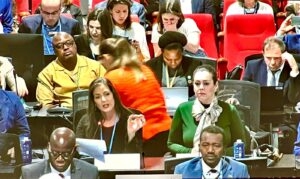
As a representative of Latin America of Local Governments and Municipal Authorities (LGMA) Constituency, The Mayor of Palmas, Cinthia Ribeiro, reinforced at the meeting the importance of multi-level action for the implementation of the second phase of the Paris Agreement and the Glasgow Climate Pact. “We see in the SURGe Initiative the potential for a well-structured agenda of collaboration, communication, and engagement at various levels with the Parties to the UNFCCC. We are ready to contribute and co-create with the COP27 Presidency, the Parties, and UN-Habitat in this initiative. We ask all Parties to support the initiative and provide the necessary coordination and funding. I am hopeful that, through our strong culture of action and collaboration with all the Pan-Amazonian cities involved, we will be able to make an important contribution to this initiative.”
Climate adaptation and justice dominate the agenda.
Despite contributing significantly less to global warming, cities in the Global South suffer the most from the effects of major crises, such as pandemics and climate-related disasters. In this context, efforts towards a just energy transition, the implementation of healthy, circular, inclusive and sustainable food systems, the fight against deforestation and the recovery of degraded areas make up the mosaic of initiatives that have been developed and defended by local and subnational governments in the region, and have found resonance in the newly elected national government in Brazil, the largest country in South America.
Leaders understand that by strengthening energy and food security, for example, territories also have the opportunity to combat energy poverty, hunger, and inequality, become more resilient, encourage innovation and the use of technologies, create green jobs, generate income, reduce greenhouse gas emissions, and advance the goals of the Paris Agreement. "Adaptation policies in territories that guarantee equity and justice are essential for local and regional governments," says Diaz.
Due to the impacts caused by the climate crisis, felt more and more intensely and frequently throughout the world, the Executive Secretary of ICLEI South America, Rodrigo Perpétuo, believes that the implementation of adaptation actions, aligned with Climate Justice, tends to strengthen even further in the upcoming COPs. “Since COP26 in Glasgow, this agenda has been gaining momentum and the trend is that it will dominate negotiations in the coming years because the repetition and intensity of extreme events are becoming more pronounced and affecting cities and populations, especially the most vulnerable.”
Multilevel partnerships
In this context, an alliance was formed on November 10th, based on an exchange promoted by ICLEI, between representatives of local governments in Brazil and Mozambique. Mayors Axel Grael of Niterói, Ary Vanazzi of São Leopoldo, and Manuel de Araújo of Quelimane, along with the Secretary of Agriculture and Fisheries of Maricá, Julio Cesar Santos, signed the Sinai Charter. In addition to strengthening cooperation between Portuguese-speaking communities, the partnership aims to promote the regular exchange of experiences on urban food systems and mobility, contributing to public policies in these areas.
“COP has been a great opportunity for networking and presenting these initiatives to potential partners, as well as a great platform for exchange with other cities and regions of the world, especially with Africa and Asia as regions of the Global South,” says Diaz.
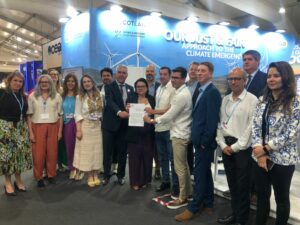
With the support of ICLEI, another important alliance was formed on November 12th by representatives from the states of Santa Catarina, Rio Grande do Sul, Paraná, and Mato Grosso do Sul., Through the Development and Integration Council (Codesul), the four Brazilian states, with economies based on agriculture and livestock farming, committed to establishing goals for promoting sustainable standards for primary sector activities and to developing a Low-Carbon Agriculture Plan. The Memorandum of Understanding also foresees the strengthening of policies and measures to achieve zero illegal deforestation, forest restoration, the gradual replacement of fossil fuels, and joint action against the climate crisis.
The largest delegation from South America at a COP.
With over 70 representatives and participation in more than 40 events in Sharm el-Sheikh, the ICLEI South America Delegation included two governors (Krist Naranjo and Renato Casagrande), six Brazilian state governments (Rio Grande do Sul, Santa Catarina, São Paulo, Pernambuco, Minas Gerais and Espírito Santo), one Chilean regional government (Región de Coquimbo), seven mayors (Axel Grael, Cinthia Ribeiro, Ary Vanazzi, Gonzalo Duran, Carolina Leitao Álvarez-Salamanca, Alvaro Henry Barrera and Gonzalo Braidot) and 14 cities (São Paulo, Niterói, Palmas, Porto Alegre, São Leopoldo, Tópaga, Intendencia, Avellaneda, Peñalolen, Maricá, Esteban Echeverría, Rosario, Rio de Janeiro and Belo Horizonte) from four countries (Argentina, Brazil, Chile and Colombia). “This is the largest delegation that ICLEI South America has ever taken to a COP, and numerous experiences and success stories were presented and are being developed in the territories, both from the governments that went to Egypt and from those that were unable to participate in the Conference,” Perpétuo highlighted.
The Executive Secretary also highlighted that the main message from COP27 is the implementation of climate action, especially in cities. “Continue to mainstream the climate agenda, deepening the climate criteria in each of the public policies, and working to ensure that the national governments of your countries recognize the importance of municipalities in their NDCs and national climate policies. Only in this way will we be able to increase access to resources to scale up the implementation of the climate agenda as urgently as possible,” Perpétuo encouraged.
Below are some low-carbon, nature-based, equitable, resilient, and circular initiatives being developed in the region and presented at events such as “Resilience in Latin American Cities – Losses and Damages at the Subnational Level,” “Climate Justice in Brazilian Cities – Challenges to Addressing Climate Change and Social Inequality,” “Ibero-American Green Cities,” and “Nature-Based Solutions and Circular Development Strategies to Address the Climate Emergency in Latin America,” which took place at the Multilevel Action Pavilion (ICLEI LGMA Pavilion);“A (truly) just transition: energy transformation happens in cities.”"And 'From Glasgow to Sharm El-Sheikh: Progress in the Race to Zero Campaign and New Investments', which took place at the Brazil Climate Action Hub, among other events.".
Green jobs
The city of São Paulo, a partner of the ICLEI LGMA Pavilion at COP27, is developing the Green Sampa Program, a startup accelerator space focused on environmental issues, and the PanClima SP, which includes more than 40 actions to address climate issues, such as the creation of green jobs. The states of Pernambuco and [other states] are also moving forward with their Climate Action Plans., São Paulo, Minas Gerais and the cities of Porto Alegre and Palmas (which announced at COP27 the implementation of ICLEI's Full Climate Compliance – Climate Governance, GHG Emissions Inventory, Climate Risk and Vulnerability Analysis, Climate Action Plan and Climate Regulations.).
Food systems and food security
São Paulo, the largest city in South America, with 30% of rural territory and 48% of green cover (the goal for 2024 is 50% of green cover), is developing the projects. Sampa+Rural e Connect the Dots promoting local and organic agriculture and payment for environmental services. In Maricá, a city in the state of Rio de Janeiro, Agroecological squares and edible gardens They are a benchmark in urban agriculture in the Global South. To reduce waste and extend the shelf life of food, the municipality also has... Mayor Édio Muniz Dehydrated Products Factory. Maricá also participates in Urban Laboratory for Public Food Policies (LUPPA), the largest city-based laboratory in the area of food systems in Brazil.. LUPPA is a collaborative platform that facilitates the development of integrated, participatory, and systemic municipal food policies, conceived by Comida do Amanhã and implemented in conjunction with ICLEI South America.
Governance and Climate Justice
Niterói, the first Brazilian city to create a Municipal Secretariat to address climate issues in a cross-cutting manner, is also a benchmark in climate governance. It established the Intersecretarial Committee for Adaptation and Mitigation of Climate Change – COMCLIMA and the Niterói Youth Forum on Climate Change and, more recently, the “Municipal IPCC”"So that universities can provide the city government with climate data to create more effective public policies. In addition, it created a social currency, called..." Araribóia, which encourages the adoption of climate action in vulnerable communities. There are dozens of other initiatives underway, such as Quito's Nature-based Solutions strategy, and water management in Independencia and Peñalolen.
Just energy transition and circular economy
Palmas presented the project at COP27. Palmas Recycles, This initiative, which received mentoring from the Amazon for Climate project, aims to fully structure selective waste collection, from awareness-raising to the proper final disposal of recyclables and waste, integrating waste pickers. In Porto Alegre, through the Action Fund, Through an initiative managed by ICLEI and funded by Google.org, photovoltaic panels and biodigesters were installed in two municipal schools in vulnerable communities. In addition to reducing electricity bills, the circular initiative also promotes a reduction in the use of cooking gas, through the generation of biogas from organic waste produced in the schools. Now, the municipality plans to implement [further details/information about the project]. electrification of the bus fleet. In Argentina, Avellaneda has an Energy Efficiency Policy and Rosario is testing one. pilot project for a public bicycle system with cargo baskets., a sustainable mobility option designed for workers, business owners, and merchants for transporting packages in the city center. The initiative is part of the project “EcoLogistics: Low-Carbon Freight Transport for Sustainable Cities“", funded by the International Climate Initiative (IKI) of the German Federal Ministry for the Environment, Nature Conservation, Nuclear Safety and Consumer Protection (BMU) with the support of ICLEI. And Santa Catarina announced at COP27 the opening of a bidding process for the purchase of electric buses. based on project support TUMI E-Bus Mission, which has the support of ICLEI.
Put: Cibele Carneiro
[email protected]
 Português do Brasil
  Español
  English (UK)