

Between July 14 and 16, the High-Level Political Forum on Sustainable Development (HLPF), a global forum for monitoring the United Nations' 2030 Agenda, took place in New York City. The 2030 Agenda is guided by the Sustainable Development Goals (SDGs), and since its establishment, ICLEI has played a central role in engaging local governments in this annual monitoring, which is embodied in the HLPF.
Although conceived at an international level, the SDGs depend heavily on the engagement of local initiatives for their implementation. This year, during the Forum, the Global Taskforce for Local and Regional Governments launched its annual monitoring report on the implementation of the 2030 Agenda, with a specific survey of progress on SDG 11: Sustainable Cities and Communities.
As part of the ICLEI global network delegation, the Brazilian city of Sarzedo (MG) was present, represented by the Deputy Municipal Secretary of the Environment, Vinicius Batista.
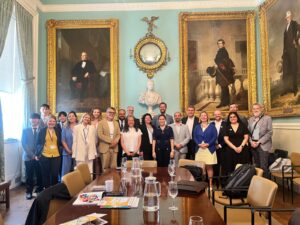
One of the main topics for the delegation at the Forum is the launch of the Sarzedo Local Voluntary Report (RVL), presented as a successful initiative at the HLPF. The report is the result of an agreement signed between the City Hall, the company Itaminas, and ICLEI South America, facilitating the identification of the SDGs and their targets at the municipal level, as well as providing a platform where governments can share their experiences and practices in implementing the SDGs.
Sarzedo's RVL (Regional Value Stream Map) was initiated in 2025 with the purpose of evaluating and disseminating the municipality's progress towards the 2030 Agenda. Therefore, the document's strategy is guided by the 17 SDGs and allows for the alignment of local priorities and city initiatives with the Sustainable Development Goals.
The launch of the RVL within the HLPF framework is a historic opportunity for Sarzedo to take a leading role, as it places the municipality in one of the most important global spaces for monitoring and debating the implementation of the 2030 Agenda. By presenting its experience at a United Nations forum, the city reinforces the strategic role of local governments in achieving the Sustainable Development Goals and becomes part of a set of international references on the localization of the 2030 Agenda. The initiative also highlights the potential of partnerships between the public sector, the private sector, and international organizations to accelerate the implementation of the SDGs.
 Português do Brasil
  Español
  English (UK)