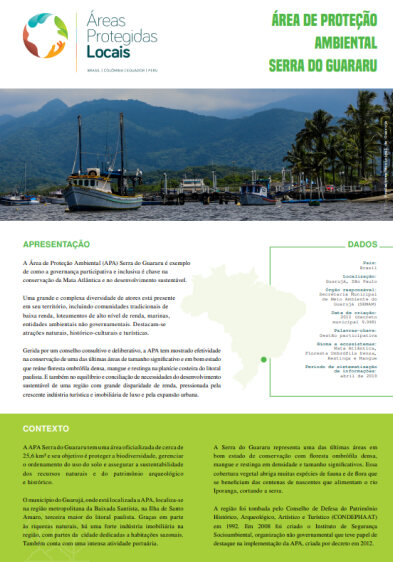
The strong performance of the management council and the participatory approach to planning are key components for the management of the conservation unit (UC) endowed with natural, historical, cultural and tourist attractions on the coast of São Paulo. Heterogeneous and complex, the diversity of actors that make up the territory is involved in the management process, including three low-income traditional communities, seven high-income housing developments, private marinas and non-governmental organizations.
Resources for managing the protected area come not only from the municipal environmental fund, but also from partnerships with the private sector, state and federal conduct adjustment agreements, and various environmental compensations. Within the protected area, public visitation programs, environmental education initiatives, and projects with universities are developed.
In 2018, ICLEI – Local Governments for Sustainability conducted a survey and systematization of experiences in the management of local protected areas through a call for proposals for municipal conservation units. The selection of best practices qualitatively assessed the availability of information, the existence of consolidated experiences, the time and process of implementation, and the scope of replicability.
 Português do Brasil
  Español
 English (UK)