

As the world navigates overlapping environmental crises and geopolitical tensions, one message is becoming increasingly clear: sustainable urban development cannot be separated from climate and biodiversity agendas. This was the central message presented by ICLEI – Local Governments for Sustainability during the second session of the UN-Habitat Assembly, UNHA 2.2, held in Nairobi, Kenya, from 29-30 May 2025.
Officially convened only every four years, the UN-Habitat Assembly is the highest global decision-making body on sustainable urbanisation and human settlements. This edition marked a critical moment for the adoption of a new strategic plan. Following extensive negotiations, Member States endorsed a framework with stronger references than ever before to urban sustainability, climate and nature. For ICLEI and the Local Government and Municipal Authorities Constituent Group (LGMA), the session reaffirmed a global truth: no urban development can be successful without respecting planetary boundaries.
Space dedicated to cities, regions and urbanisation at COP30
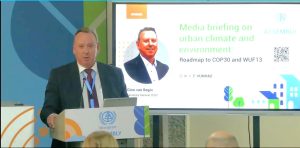
On 29 May, ICLEI Secretary General Gino Van Begin participated in the UN-Habitat climate press conference, where he offered a preview of what is to come in the preparations for COP30. At the event, he announced the preliminary launch of the COP30 Cities and Regions Hub, a joint initiative by ICLEI, UN-Habitat, and the Brazilian Ministry of Cities.
The Hub will serve as a central platform to bridge the COP30 Local Leaders' Summit, to be held in Rio de Janeiro on 4-5 November, and the COP30 negotiations in Belém, just a few days later. Building on ICLEI’s experience with the Multilevel Action and Urbanisation Pavilions since COP26, this space will give local and regional governments the visibility and access they need to help shape global climate policy.
“This inclusive space will set the global scene for high-impact exchange, advocacy and visibility of local and regional climate action,” Van Begin said. “It will inform Parties on climate efforts at multiple levels within the negotiation zone and bring the outcomes of a year-long effort to COP30.”.
As confirmed by the UN-Habitat Executive Director, Anacláudia Rossbach, the Hub will also be linked to the fourth Ministerial Meeting on Urbanisation and Climate Change at COP30, co-convened by UN-Habitat and the Government of Brazil. These coordinated efforts will firmly anchor local leadership in the multilateral process.
Community effort and the spirit of collective action
The concept of a collective effort, adopted by the Brazilian presidency of COP30, became a defining theme of the year. With roots in indigenous knowledge, the "mutirão" refers to a collective task where people work together towards a common goal. This framing was well reflected in the Nairobi meetings.
“In an era of fragile multilateralism, it is essential to offer integrated, holistic, and ambitious climate action as a positive and collective response to the challenges of a fragmented world,” said Van Begin.
Mobilising local voices for climate action
The year 2025 is a pivotal moment. The Nationally Determined Contributions (NDCs) are being reviewed and updated, and the new round – named NDC 3.0 – is expected to reflect not only ambition but also implementation. According to the ICLEI Secretary General, this means building on the outcomes of previous COPs and mobilising action before, during, and after COP30.
“Success at COP30 depends on mobilising domestically now,” Van Begin stated. “All countries, especially those committed to the CHAMP initiative, must formulate and adopt their national climate plans with strong collaboration across multiple levels.”.
ICLEI is supporting this process, encouraging local and regional governments worldwide to convene their own Town Hall COPs, inclusive national dialogues designed to shape community-led, transformational climate action. Early examples have already emerged in cities across Australia, Brazil, Malaysia, South Africa, South Korea, Turkey and the United States.
ICLEI is also calling on UN-Habitat and pioneering national governments to organise national editions of Urban and Climate Ministries. These meetings could feed directly into the fourth Ministerial Meeting in Belém and strengthen the urban dimensions of the Paris Agreement.
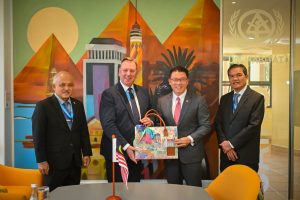
Furthermore, Van Begin held a bilateral meeting with YB Nga Kor Ming, Malaysia's Minister of Housing and Local Government and newly elected President of the UN-Habitat Assembly for the 2025-2027 term. The discussion focused on strengthening collaboration ahead of COP30, with a particular emphasis on the ASEAN Mayors Forum and the Kuala Lumpur Mayoral COP as pillars of regional engagement. The meeting reaffirmed Malaysia's leadership in amplifying the voices of local governments across Southeast Asia and highlighted the country's active role in advancing multilevel action in the COP30 process.
Partnership expansion for implementation
The Nairobi session also highlighted the revitalisation of the C40 Cities Partnership between UN-Habitat and the UN Environment Programme (UNEP). Announced by UNEP's Director of Climate, Martin Krause, the renewed partnership will focus on three priorities: low-emission, resilient, and accessible buildings and neighbourhoods; resilient infrastructure and access to basic services; and inclusive and biodiverse urban planning and design.
These areas directly support the work of cities in tackling the triple planetary crisis of climate change, biodiversity loss, and pollution. ICLEI welcomed this renewed commitment as a further sign that the urban-climate-environment nexus is finally receiving the global attention it needs.
During his stay in Nairobi, Van Begin also participated in the preparatory meeting for the Baku Continuity Coalition for Urban Multisectoral and Multilevel Climate Action, a growing alliance supporting continuity between COP presidencies. He also held a bilateral meeting with the UNEP Cities Unit to align future workflows.
From Nairobi to Bonn and Belem
The Nairobi results will feed into the UNFCCC negotiations in SB62 in Bonn, Germany, where ICLEI and the Federal City of Bonn will convene the Bonn Dialogues of Daring Cities 2025, from 16 to 18 June. These mid-year dialogues will provide an opportunity to reflect on progress and align local action with global processes ahead of COP30.
With COP30 approaching, ICLEI's message remains clear: there is no implementation without localisation, and there is no sustainability without cities and regions. From Nairobi to Belém, ICLEI continues to bridge global sustainability and urban agendas, transforming words into actions and strategies into systemic change.
 Português do Brasil
  Español
  English (UK)