Within the framework of Climate Week Medellín 2026, this meeting will bring together territorial leaders, national governments, multilateral organizations, development banks, international cooperation, the private sector and city networks on September 28 to promote alliances, financing and commitments that accelerate climate action from the territories.
The Summit of Local and Subnational Governments is a high-level political space that seeks to position cities and regions as key actors in accelerating the implementation of the global climate agenda.
This is part of an increasingly evident reality: although climate commitments are forged in international forums, their implementation takes place on the ground. It is there that decisions are made about mobility, infrastructure, energy, land management, biodiversity, and economic development, and where the impacts of climate change and biodiversity loss become tangible for communities.
After decades of building international agreements and goals, the current challenge is to accelerate their implementation. However, local and subnational governments still face barriers to accessing climate finance, strengthening their institutional capacities, and connecting their priorities with available cooperation opportunities.
In this context, the Summit seeks to help close this gap and create conditions for global climate ambition to translate into concrete decisions, resources, partnerships and solutions for cities and regions.
A space to connect leadership, cooperation, and resources
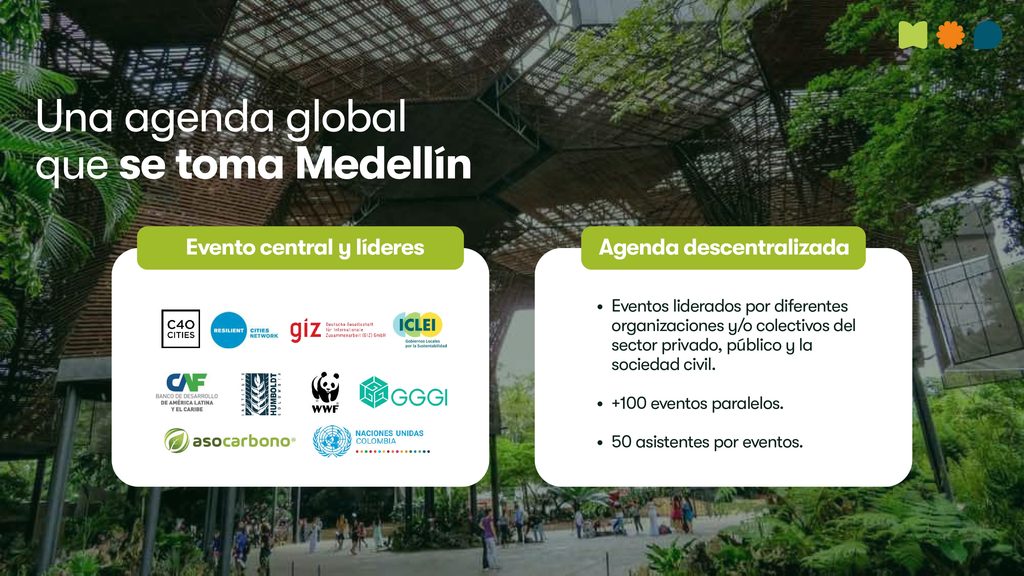
As the main high-level political space of Climate Week Medellín, the Summit will bring together representatives of local and subnational governments, national governments, multilateral organizations, development banks, international cooperation, the private sector and city networks.
The meeting will promote dialogue on some of the main challenges and opportunities of territorial climate action, as well as the exchange of experiences and solutions with the potential to be replicated and scaled up in Latin America and the Caribbean.
The agenda will include discussions on climate action and biodiversity, urban transformation, nature-based solutions, technical and financial cooperation, and mechanisms to strengthen territorial implementation.
Among the highlights is the discussion “Local Management for Climate Action and Biodiversity”, led by ICLEI, which will bring together governments from different territories to share experiences, challenges and lessons learned on strengthening resilience and implementing international commitments.
The program will also feature a high-level panel led by C40 on urban transformation and decarbonization, a CAF space on the leadership of BiodiverCities in Latin America and the Caribbean, and a panel dedicated to Nature-based Solutions to climate risks.
The day will conclude with a space to present new projects, coalitions, calls for proposals and commitments, as well as recognizing outstanding experiences of local governments and allies that are promoting innovative solutions from the territories.
Learn about the agenda of the Summit of Local and Subnational Governments
Medellín Declaration: Local Leadership for a Resilient Future
One of the central moments of the day will be the presentation of the Medellín Declaration – Local Leadership for a Resilient Future, an initiative that seeks to strengthen the leadership of local and subnational governments and accelerate the implementation of solutions to climate, environmental and development challenges.
The Declaration recognizes that territories directly face these challenges and that, at the same time, it is local and subnational governments that have the decisive powers and capacities to turn commitments into actions.
Therefore, it raises the need to strengthen the connection between territorial priorities and available resources, financing mechanisms, capacities and cooperation opportunities.
In this process, ICLEI plays a coordinating and facilitating role, connecting the voices, experiences, and priorities of local and subnational governments with spaces for international environmental cooperation and governance. In this way, it seeks to contribute to ensuring that the perspectives of these territories have a greater presence in global conversations and that these connections translate into new opportunities for action.
Join the Medellín Declaration!
Mayors meet to promote a regional agenda
As part of the Summit, the Mayors' Meeting for Climate Action will also take place, a private space for political dialogue that will bring together local authorities to address the main challenges and opportunities facing their territories.
The meeting will allow participants to exchange experiences, identify common interests, and explore opportunities for cooperation and investment, with the aim of strengthening relationships between cities and advancing alliances that can transcend Climate Week Medellín.
One of the highlights will be the presentation of the Medellín Declaration by the mayor of Medellín, followed by speeches from signatory authorities and an invitation to other governments to join this call for greater territorial leadership.
Medellín, a meeting point for climate action
Climate Week Medellín 2026, which will take place between September 28 and October 10, seeks to consolidate itself as a climate action platform for the Global South, connecting a central high-level agenda with more than one hundred decentralized events in the city.
The initiative will bring together governments, businesses, academia, international organizations, investors, civil society organizations and citizens around six major themes: sustainable cities, nature, energy, circular economy, climate finance and carbon markets.
In this scenario, the Summit of Local and Subnational Governments seeks to send a clear message: territories are not only the place where global decisions are implemented; they are protagonists and accelerators of climate action.
Medellín will thus become a meeting point to connect political leadership, cooperation, knowledge and resources, and to demonstrate that when global commitments find capabilities and alliances in the territories, they can become concrete solutions for people, local economies and ecosystems.
 Español de Colombia
  Português do Brasil
  English (UK)