The municipality, an ICLEI member since 2022, seeks to transform this space into a green lung for Santiago through efficient water management, environmental restoration, and long-term planning.
March 27, 2026
In Renca, a district located in the northwestern part of Santiago, Chile, and marked by profound inequalities in access to green spaces, the municipality is promoting one of the city's most ambitious urban and environmental regeneration projects: the transformation of 200 hectares of the Renca Hills into a metropolitan park. The initiative combines ecosystem restoration, innovative water management, and public-private partnerships to reclaim this area as a space for biodiversity, climate mitigation, and community gathering.
A member of the ICLEI Network – Local Governments for Sustainability since 2022, the municipality has also integrated an impact-based approach and nature-based solutions into its urban planning. In this interview, Mayor Claudio Castro Salas explains how the Cerros de Renca Metropolitan Park project came about, the role of the Water Master Plan, and why this initiative aims to become a benchmark for urban and environmental justice in Chile.
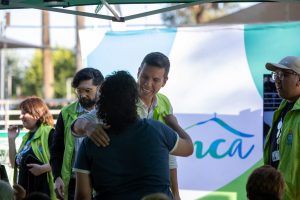
— What is the Cerros de Renca Metropolitan Park and what territory does it cover?
The Cerros de Renca Metropolitan Park is a complex of hills covering 839 hectares located north of Renca, bordering the Quilicura district. Two hundred of these hectares, between Cerro Colorado and Cerro Renca, are owned by the municipality. And it is this land that we are working to transform into an urban park that will be a symbol of social justice.
— What urban and environmental problems in the territory does this project seek to address?
Renca is located in the northwestern part of Santiago, a city that is very unequal. As you move eastward, all the indicators improve, closely linked to the income levels of the people who live there. Among the city's many inequities, Renca has fewer green spaces per capita than the eastern sector.
Transforming those 200 hectares of the Renca Hills is a project of territorial justice because it increases green areas per inhabitant in this area of the city; but also of environmental justice, because the northwest area of the city of Santiago, where Renca is located, is the area with the highest concentration of pollutants, due to the geographical characteristics of the city of Santiago.
What we have in Renca and the surrounding area is a heat island, a consequence of the concentration of polluting gases that aren't necessarily generated within our territory but reach our area. That's why the Renca Hills, developed as an urban park, as a regenerating ecosystem, will have an increasing capacity to capture equivalent carbon and partially mitigate the rise in temperatures. That's what this project represents today.
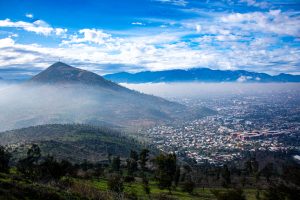
—How did the process of recovering the Renca Hills begin?
—This is a very important aspiration of our community. The hills of Renca have always dreamed of becoming a park. Many previous municipal administrations also had this idea. However, as there were changes in municipal administration, it always seemed to be an idea that started from scratch.
What we did, with the intention of preventing this from happening again, was to begin developing a Master Plan with significant community participation. More than 7,000 residents participated in various activities alongside Teodoro Fernandez, a Chilean National Architecture Prize winner, who gathered all these ideas and transformed them into an urban park project. That's how this process began.
Perhaps one difference from previous times is that we started with this Master Plan, which gave us a roadmap to move forward, and we have been following that path. We have planted more than 80,000 trees, developed a large area with trails and viewpoints, and established governance structures: we have a team that manages this territory and is also making it available for use by our community.
As we progressed with the execution of the infrastructure works associated with this Master Plan, we realized that we had to incorporate two other perspectives.
One was ecosystem recovery, and for that we made a second Master Plan, linked to soil treatment techniques to be able to regenerate it and think about how we reconnected biodiversity with the characteristics that the hills have.
The other issue concerns water. This led us to develop a third Master Plan, which would allow us to identify where we would sustainably obtain water for the park's development, while also determining how we would use that water. This includes irrigation systems, fire prevention and control, and drinking water for people.
—This is very interesting. Can you give us more details about this Water Master Plan?
What we wanted was to develop a water management model that would be sustainable over time. The La Punta underground canal runs at the foot of Cerro Renca.
Initially, we had considered that canal as the main source of water for designing our Master Plan, but we ended up realizing that this was not going to be sustainable over time, because with the water crisis that the city of Santiago is experiencing, this canal has decreased its capacity in terms of water flow.
That's where a more innovative idea began: identifying the potential of our industrial wastewater. In Renca, we have two industrial parks. What we did was identify which companies use water for their industrial processes, then treat it and return it to the sewer system. The question was how we could use that water to supply the hills of Renca and develop solutions for our needs: irrigation, fire prevention, and drinking water.
That's how we started this project. First, we established a public-private partnership. The first thing we ensured was that there were companies willing to supply us with water for use in the hills. Then we had to design this Master Plan. We did it with international funding, implemented in partnership with an academic institution in Chile. This design includes the entire network of pipes, pumps, water storage tanks, and the locations where they need to be situated within those 200 hectares to make this system efficient.
Today we are completely focused on implementation, which requires a significant amount of resources that we also intend to obtain through public-private partnerships. A business network is raising approximately $15 million to implement this Master Plan.
And we are very happy because it is a process that is moving forward: the first stage has already begun, which is the network of pipes that will take the water from the Coca-Cola Andina company, a bottling plant that is in our commune and, through underground pipes, takes it to the first accumulation tank, which is at the foot of the Colorado hill.
The amount of water used by Coca Cola Andina in its industrial processes is perfectly sufficient for the water needs we have in the Renca Hills.
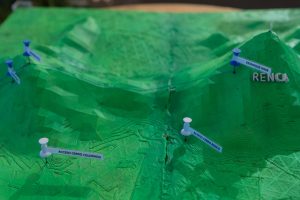
—What impacts do the Park and the Water Master Plan have on the ecosystems of Renca?
The park has a multifaceted impact. When we developed the second Master Plan for soil and biodiversity regeneration, we realized that without a sustainable and guaranteed water supply, things would be much more difficult. That's why we focused on the impact this would have on biodiversity, soil regeneration, the capacity to capture tons of carbon equivalent, and the potential reduction in water consumption.
Obtaining water from a treated source allows us to simultaneously enrich the aquifers in the hills and canals without using the water that comes from those same canals. This also has the potential to reduce surface temperatures within the park by 1 to 4 degrees Celsius.
A second impact relates to the quality of life of our residents. Having access to a park allows our neighbors to live healthier lives, connect with the environment, and improves both their quality of life and the neighborhood's surroundings. And we have been quantifying all of this. Today, we also know the economic value generated by this impact. A healthier life has an associated economic value; capturing or mitigating both heat and carbon has an associated value; and the improvement of the neighborhood has the potential to create associated economic value.
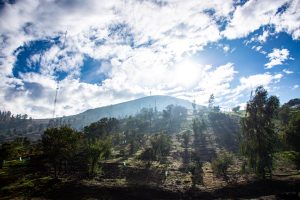
—What is the importance of public-private partnerships within this process?
Specifically, the third impact of this project has to do with what it means to value public-private partnerships and collaboration when pushing forward a project like this.
The project wouldn't be progressing the way it is if we hadn't been able to connect our community, from the municipality, with the private business sector, which now helps finance it and is an integral part of this process. But it also put us in touch with an international ecosystem that provides us not only with resources, but also with technical and financial capabilities.
—When and how did you begin to incorporate nature-based solutions (NbS) into the planning of the municipality of Renca?
I would say that our understanding of this process changed when we started attending the COPs. Before, we checked off a damaged space when we transformed a plaza into a green space. Now the question is: what is the impact of all these solutions? How many tons of carbon equivalent are they able to capture? What is the impact on temperature? And eventually, how does it connect with the rest of the ecosystem in that environment?
We started thinking about the impact, not just the solution, in 2019, when we were going to host COP25 in Chile, but ultimately, due to the social unrest we experienced that year, it ended up being held in Madrid. However, that was a turning point for us, when we began to measure what we were doing, when we started to communicate using a common language within the framework of the Race to Zero and the Race to Resilience, when we began to report on the work we were doing in Renca through various indicators. And that's when we truly incorporated Nature-based Solutions (NBS).
Based on that same vision, we have brought together stakeholders who have allowed us to create designs, for example, for entire streets, which are being built by the Ministry of Public Works of the Central Government, but are located in Renca. I'm thinking in particular of our Condell Avenue, which connects the hills of Renca with the Mapocho River. This is a megaproject that was being designed by the Ministry of Public Works, but thanks to the work we have done from the municipality with institutions like ICLEI – Local Governments for Sustainability, since it was the focus of the work we did with the program. Cities Forward, We succeeded in incorporating a cutting-edge perspective into the design of nature-based solutions, a vision they had not previously incorporated.

—What do you think will be the main legacy of the Cerros de Renca Metropolitan Park for the community?
The first and most relevant one has to do with the impact generated by the Renca Hills transformed into a park, in terms of improving the quality of life of our community.
This long-held dream of the residents of Renca—to see the hills green year-round and with the infrastructure to enjoy them—is about to become a reality and will impact the quality of life not only in Renca but throughout the entire city of Santiago. This is a metropolitan-scale project, and that legacy will speak for itself and continue to evolve, becoming an even better park.
The second point relates to impact. This project leaves as a legacy for other projects underway in Renca and throughout Chile a working method that focuses on impact and the scale of what we ultimately want to achieve.
When we talk about improving quality of life related to healthy living, when we talk about reducing the impact of climate change by containing the temperature increase or capturing equivalent carbon emissions, these are issues that don't simply arise from the existence of a project. They must be measured, they must be evaluated, they must follow a design process that focuses on the impact that the project will have.
And the way in which the Cerros de Renca park has been executed conditions the way in which other projects will continue to be executed in our commune and also in our country.
And the third point is that this is also a flagship project in terms of what public-private partnerships mean. It's a policy driven by the local government in the city, but it connects the support of the regional government, the central government, an international ecosystem, and all the companies that are currently financing the arrival of water to the hills.
 Español de Argentina
  Português do Brasil
  English (UK)